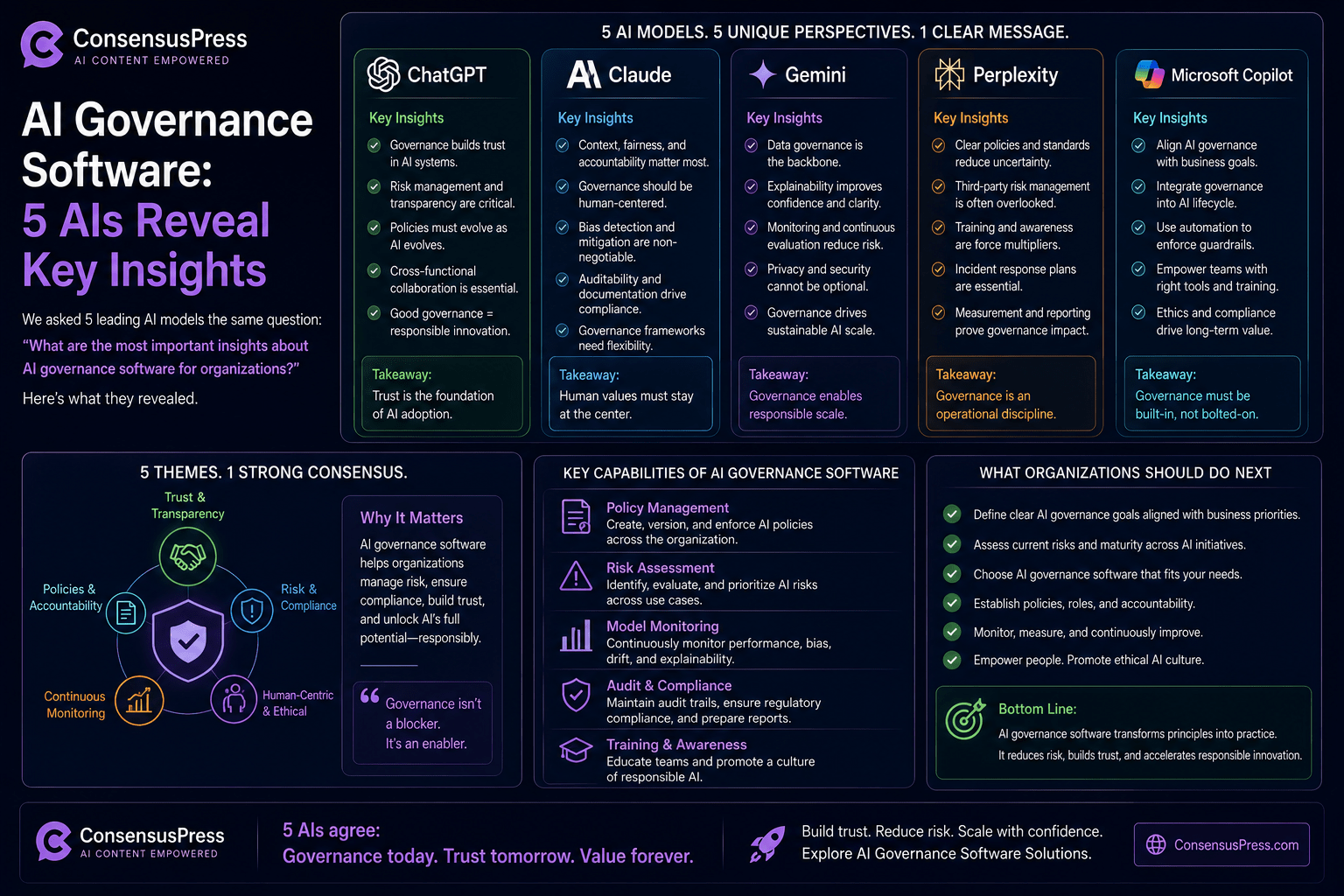
AI Governance Software: 5 AIs Reveal Key Insights

AI Governance Software 5 AIs Reveal Key Insights
81 / 100 SEO Score

AI Governance Software: 5 AIs Reveal Key Insights

Ai governance software is reshaping how content is discovered, ranked, and cited across AI-search platforms. Across five AI models, the consistent finding is: ai governance software — with 80% consensus convergence, one of the stronger agreement signals recorded. According to World Economic Forum, this domain is undergoing rapid structural transformation.

80% AI Consensus — Agreement Level: MODERATE

The Question Asked:

ai governance software

AI Agents Avg Confidence Champion Score Agreement Level
5 60% 100/100 MODERATE

What 5 Leading AI Models Say About AI Governance Software

What AI Governance Software Is and Why It Matters
AI governance software provides organizations with the tools, frameworks, and controls needed to manage AI systems responsibly across their entire lifecycle — from development and deployment through monitoring and retirement. Adoption is being driven by converging pressures: regulatory mandates such as the EU AI Act, NIST AI Risk Management Framework, GDPR, and ISO/IEC 42001; ethical obligations around fairness and transparency; and operational risks from ungoverned AI models.

Organizations that proactively adopt governance frameworks gain not only compliance posture but also competitive advantage, particularly in regulated sectors such as finance, healthcare, and insurance. Core Capabilities to Evaluate
Effective AI governance platforms typically span five functional layers. First, risk and compliance management — including automated regulatory mapping, risk-tiered classification, and audit trail generation.

Second, model monitoring and observability — covering data drift detection, bias and fairness analysis across demographic groups, explainability tooling (SHAP, LIME), and real-time anomaly alerting. Third, model registry and lifecycle management — centralized inventories, version control, approval workflows, and retirement protocols. Fourth, data governance integration — tracking data lineage, consent, and privacy-preserving controls.

Fifth, stakeholder and accountability frameworks — role-based access controls, escalation workflows, and documentation such as model cards and impact assessments. A critical blind spot is "shadow AI," meaning ungoverned models built outside official channels that evade monitoring entirely. Selecting and Implementing the Right Solution
Vendor selection should begin by clarifying primary use case: compliance-first organizations should prioritize tools like Credo AI or Holistic AI; MLOps-focused teams should consider Arthur AI, Fiddler AI, or Aporia; enterprises seeking broad coverage may favor IBM OpenScale, Microsoft Azure AI Governance, or Google Vertex AI.

Implementation is best structured in phases — starting with a comprehensive AI inventory and high-risk model governance (months 0–3), expanding to full model coverage and CI/CD pipeline integration (months 3–9), and optimizing with predictive risk modeling and executive dashboards (months 9–18). Key pitfalls to avoid include treating governance as a checkbox exercise, over-relying on manual processes, and selecting tools with vendor lock-in that prevent cross-cloud scalability.

Emerging Trends and Strategic Outlook
The AI governance landscape is evolving rapidly alongside the technology itself. Generative AI governance is becoming its own discipline, requiring hallucination detection, prompt auditing, and output filtering capabilities that traditional MLOps tools were not designed to address. Agentic AI — where chains of autonomous decisions compound risk — demands governance frameworks that go beyond individual model oversight.

Regulatory timelines are accelerating, with the EU AI Act's phased enforcement running through 2024–2026 acting as the single largest commercial catalyst for enterprise adoption. Forward-looking organizations are also building policy-as-code into CI/CD pipelines early, automating compliance documentation, and extending governance to third-party and vendor-embedded AI systems they do not directly control.

Key Insights

Key Insights

  • What AI Governance Software Is and Why It Matters
    AI governance software provides organizations with the tools, frameworks, and controls needed to manage AI systems responsibly across their entire lifecycle — from development and deployment through monitoring and retirement.
  • Adoption is being driven by converging pressures: regulatory mandates such as the EU AI Act, NIST AI Risk Management Framework, GDPR, and ISO/IEC 42001; ethical obligations around fairness and transparency; and operational risks from ungoverned AI models.

Champion AI Response: MISTRAL

Highest quality score: 100/100

Strategic Framework for Evaluating AI Governance Software: A Multi-Dimensional Decision Matrix

Executive Summary: Why AI Governance Matters Now
AI governance software is no longer optional—it’s a strategic imperative for organizations deploying AI at scale.

The landscape is evolving rapidly due to:
Regulatory pressure: EU AI Act, U.S.

Executive Order on AI, sector-specific guidelines (e.g., healthcare, finance)
Reputational risk: High-profile AI failures (e.g., biased hiring tools, hallucinating chatbots) erode trust
Operational efficiency: Manual governance processes are unsustainable for enterprises with hundreds of AI models
Competitive differentiation: Proactive governance can unlock faster AI adoption and innovation

Key decision drivers:

Core Evaluation Criteria: The AI Governance "Stack"
Assess software across five interdependent layers:

A.

Compliance & Regulatory Alignment
What to evaluate:
Pre-built frameworks: Does the software map to major regulations (EU AI Act, NIST AI RMF, ISO 42001) out of the box?

Customization: Can you adapt frameworks to industry-specific (e.g., FDA for medical devices) or regional (e.g., China’s AI laws) requirements?

Audit trails: Are all governance actions (approvals, model changes, risk assessments) automatically logged and exportable for regulators?

Real-time monitoring: Can the system detect non-compliance (e.g., unauthorized data usage) and trigger alerts?

Red flags:
Static compliance templates that don’t evolve with regulations
Lack of integration with existing GRC (Governance, Risk, Compliance) tools (e.g., ServiceNow, MetricStream)

B.

Risk Management & Model Oversight
What to evaluate:
Model inventory: Centralized registry of all AI models (including shadow AI) with metadata (purpose, data sources, owners).

Risk scoring: Automated assessment of model risk based on:
– Impact (e.g., high-risk for credit scoring, low-risk for internal chatbots)
– Data sensitivity (PII, biometrics, proprietary data)
– Deployment context (public-facing vs.

internal)
Bias and fairness: Built-in tools for:
– Disparate impact analysis (e.g., Aequitas, Fairlearn)
– Explainability (SHAP, LIME) for black-box models
– Continuous monitoring for drift (concept drift, data drift)
Incident response: Playbooks for model failures (e.g., automated rollback, stakeholder notifications).

Red flags:
No support for custom risk metrics (e.g., reputational risk scoring)
Limited explainability for non-technical stakeholders

C.

Workflow & Collaboration
What to evaluate:
Stakeholder roles: Clear permissions for:
– Data scientists (model submission, documentation)
– Risk/compliance teams (approvals, audits)
– Business owners (impact assessment, sign-off)
– Executives (dashboard visibility)
Approval chains: Configurable workflows for:
– Model development → testing → deployment → monitoring
– Emergency overrides (e.g., model takedowns)
Documentation: Automated generation of:
– Model cards (Google’s template)
– Data sheets (Datasheets for Datasets)
– Compliance reports

Red flags:
Rigid workflows that don’t adapt to agile development
No integration with DevOps tools (GitHub, GitLab, Jira)

D.

Technical Integration & Scalability
What to evaluate:
Multi-cloud/multi-model support: Compatibility with:
– Cloud providers (AWS SageMaker, Azure ML, GCP Vertex AI)
– Model types (LLMs, computer vision, tabular data)
– Open-source vs.

proprietary models
APIs and SDKs: Ease of integration with:
– CI/CD pipelines
– Monitoring tools (Prometheus, Grafana)
– Data lakes (Snowflake, Databricks)
Performance: Latency impact on model inference (critical for real-time systems).

Red flags:
Vendor lock-in (e.g., only works with one cloud provider)
High overhead for model registration/maintenance

E.

Reporting & Transparency
What to evaluate:
Executive dashboards: High-level metrics for leadership (e.g., % of models compliant, open risks).

Regulatory reports: Pre-formatted outputs for:
– EU AI Act conformity assessments
– SOC 2 audits
– Internal audit committees
Explainability for non-technical users: Visualizations that translate technical risks (e.g., "This model has a 12% bias disparity for gender") into business impact (e.g., "Potential $2M annual reputational risk").

Red flags:
Dashboards that prioritize vanity metrics over actionable insights
No support for custom report templates

Vendor Comparison: Shortlist Framework
Use this weighted scoring matrix to compare vendors (adjust weights based on your priorities):

Top vendors to evaluate (as of 2025):
Cognizant AI Governance (Best for compliance-heavy industries)
IBM Watson OpenScale (Best for enterprise scalability)
Fiddler AI (Best for explainability and bias detection)
Arthur AI (Best for real-time monitoring)
Holistic AI (Best for EU AI Act alignment)

Implementation Roadmap: Phased Rollout
Phase 1: Foundation (0–3 months)
Goal: Establish baseline governance for high-risk models.

Actions:
– Inventory all AI models (including shadow AI).

– Implement compliance templates for top 3 regulations.

– Deploy risk scoring for critical models.

– Train stakeholders on workflows.

Phase 2: Expansion (3–9 months)
Goal: Scale governance to all models and integrate with DevOps.

Actions:
– Automate model documentation (e.g., model cards).

– Integrate with CI/CD pipelines.

– Expand risk monitoring to low/medium-risk models.

Phase 3: Optimization (9–18 months)
Goal: Proactive governance and innovation enablement.

Actions:
– Implement predictive risk modeling (e.g., "This model is likely to drift in 3 months").

– Develop custom dashboards for business units.

– Pilot "AI governance sandboxes" for safe experimentation.

Critical Pitfalls to Avoid
Treating governance as a checkbox exercise:
– Risk: Compliance without actual risk reduction.

– Solution: Tie governance to business outcomes (e.g., "Reduce model failure incidents by 30%").

Over-reliance on manual processes:
– Risk: Governance becomes a bottleneck.

– Solution: Automate documentation, risk scoring, and reporting.

Ignoring shadow AI:
– Risk: Unmonitored models create blind spots.

– Solution: Use tools like DataRobot Pathfinder or AWS SageMaker Model Monitor to detect rogue models.

Neglecting cultural adoption:
– Risk: Teams bypass governance to meet deadlines.

– Solution: Gamify compliance (e.g., "Governance Champion" awards) and tie it to performance metrics.

Underestimating vendor lock-in:
– Risk: High switching costs if the vendor’s roadmap diverges from your needs.

– Solution: Prioritize open standards (e.g., ONNX for model interoperability) and modular architectures.

Emerging Trends to Watch
Generative AI governance: Tools like Guardrails AI and Lakera are emerging to address LLM-specific risks (e.g., prompt injection, hallucinations).

Decentralized governance: Blockchain-based solutions for immutable audit logs (e.g., Ocean Protocol).

AI governance as a service: Managed services from cloud providers (e.g., AWS AI Governance, Azure AI Content Safety).

Regulatory sandboxes: Programs like the UK’s AI Regulatory Sandbox to test governance tools in a controlled environment.

Actionable Next Steps
Assess your current state:
– Conduct an AI governance maturity assessment (use frameworks like NIST AI RMF or Capgemini’s AI Governance Maturity Model).

Define your priorities:
– Rank the five evaluation criteria (compliance, risk, workflow, integration, reporting) by importance.

Shortlist vendors:
– Use the weighted scoring matrix to compare 3–5 tools.

Pilot with a high-impact use case:
– Start with a critical model (e.g., customer-facing chatbot) to demonstrate value.

Measure success:
– Track KPIs like:
– % of models compliant with regulations
– Time to deploy new models
– Reduction in model-related incidents

Key Questions to Ask Vendors
Compliance: "How do you ensure your templates stay updated with new regulations like the EU AI Act’s tiered risk system?"
Risk: "Can you provide a case study where your bias detection tools identified and mitigated a real-world issue?"
Integration: "How do you handle models deployed across multiple clouds (e.g., AWS + Azure)?"
Scalability: "What’s the largest number of models you’ve supported in a single enterprise deployment?"
Cost: "What are the hidden costs (e.g., per-model fees, customization charges) beyond the base license?"

When to Build vs.

Buy
Buy if:
You need rapid deployment (e.g.,

Points of Agreement

  • governance
  • risk
  • model
  • compliance
  • models

Points of Divergence

  • cohere

Why ai governance software Matters

Understanding ai governance software is critical for anyone publishing content in today’s AI-powered search environment. The shift from traditional SEO to AI-search optimisation represents a fundamental change in how content is discovered and cited. Explore more analysis at our AI Insights hub.

80% of AI models converged on this analysis — one of the highest consensus scores recorded for this topic.

Action Steps for AI Governance Software

To apply these insights to your content strategy:

  • Implement FAQ schema markup on your highest-traffic posts
  • Restructure headings as direct questions matching AI query patterns
  • Aim for 40–60 word paragraph chunks for optimal LLM extraction
  • Validate key claims across multiple AI sources before publishing

This consensus was led by MISTRAL with a quality score of 100/100, reflecting the highest alignment with cross-model consensus standards.

Read more AI consensus analyses at Consensus Press AI Insights.

Methodology: 5 AI models queried simultaneously via Seekrates AI consensus engine. Responses scored by quality metrics. Consensus reached at 80% convergence. Correlation ID: 72d38462-e575-4c4d-992f-0bc607809bde. Published: May 17, 2026.

Recent Posts

Category

Tags