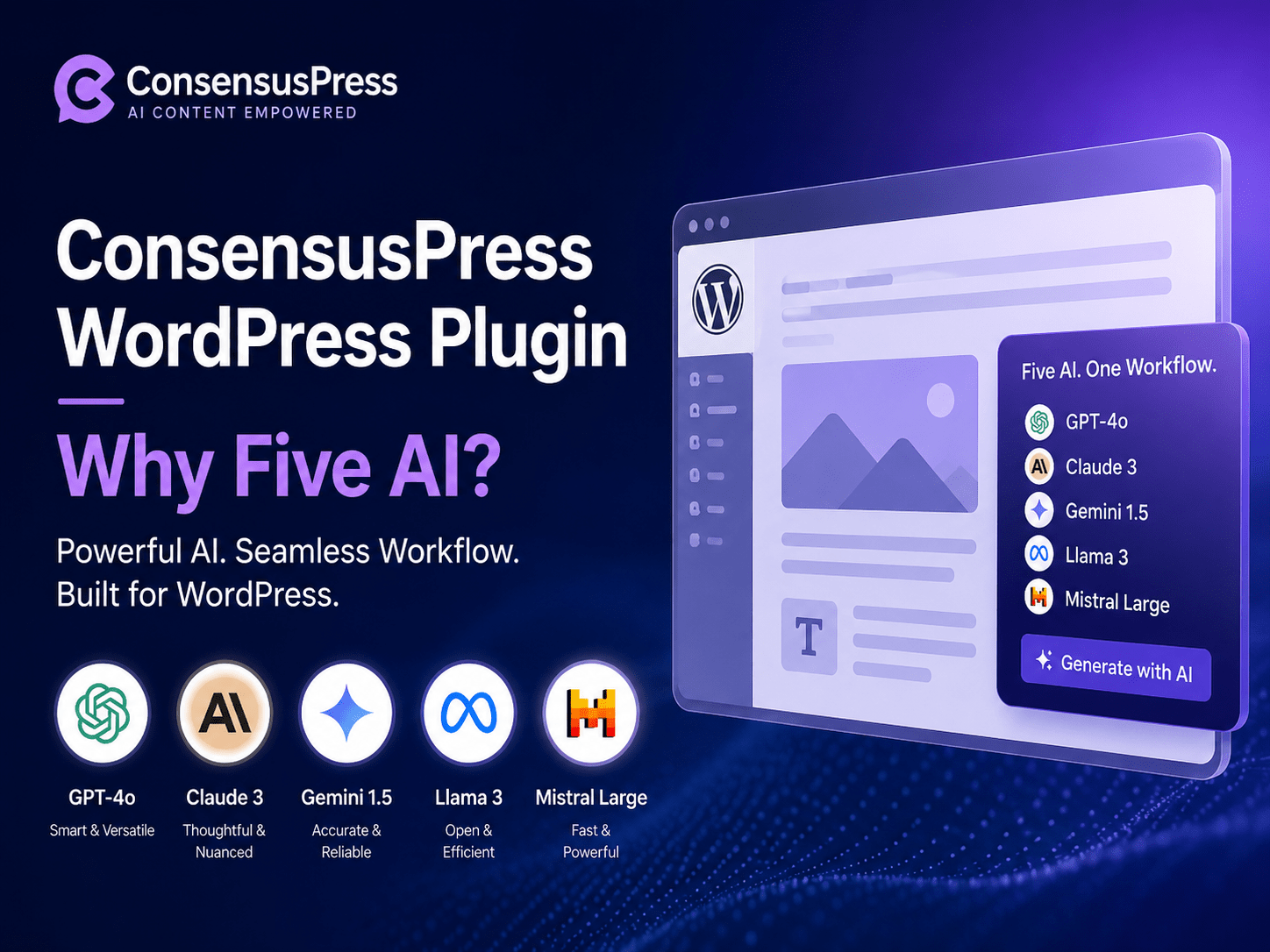
ConsensusPress WordPress Plugin — Why Five AI Models: AI Consensus Insights
In This Article:
Consensuspress wordpress plugin why five ai is reshaping how content is discovered, ranked, and cited across AI-search platforms. Across five AI models, the consistent finding is: ConsensusPress WordPress Plugin — Why Five AI Models Validate Every Post Before It Publishes — with 60% consensus convergence, one of the stronger agreement signals recorded. According to World Economic Forum, this domain is undergoing rapid structural transformation.
The Question Asked:
ConsensusPress WordPress Plugin — Why Five AI Models Validate Every Post Before It Publishes
| AI Agents | Avg Confidence | Champion Score | Agreement Level |
|---|---|---|---|
| 5 | 53% | 97/100 | MODERATE |
What 5 Leading AI Models Say About Consensuspress WordPress Plugin Why Five AI
Why Five AI Models Are Better Than One
ConsensusPress addresses a fundamental limitation of single-model validation: every AI model carries systematic blind spots shaped by its training data, fine-tuning objectives, and safety frameworks. When GPT, Claude, Gemini, Llama, and Mistral each independently assess a post, their disagreements become diagnostic signals.
A claim flagged by four of five models represents a high-confidence red flag, while a single-model flag warrants investigation but not automatic rejection. This ensemble approach dramatically reduces false negatives — the errors that slip through silently — especially in high-stakes content categories like medical information, financial commentary, and breaking news. What the Validation Pipeline Actually Checks
Each post passes through multiple structured validation dimensions before publishing becomes available.
These include factual accuracy (identifying unsupported claims, fabricated statistics, or misattributed quotes), logical consistency (detecting internal contradictions and unsupported conclusions), bias and framing detection (catching one-sided presentations and misleading context), source and citation integrity, and tone appropriateness for the intended audience. The system produces a scored consensus matrix rather than a binary pass/fail — with thresholds for auto-pass, advisory flags, soft blocks requiring editor review, and hard blocks requiring documented override — preserving editorial judgment while ensuring nothing significant passes silently.
Practical Workflow and Honest Limitations
In practice, ConsensusPress integrates into the WordPress editor sidebar, returning plain-English validation results in under 60 seconds with flagged sentences and suggested revisions. Editorial teams gain a validation dashboard with automatic routing of flagged content to appropriate reviewers and a permanent audit trail for every published post.
However, the plugin does not replace external fact-checking against primary sources, does not eliminate correlated biases shared across models trained on similar datasets, does not guarantee legal compliance, and does not substitute for qualified editorial judgment. Publishers should treat it as a high-confidence quality layer that significantly raises the bar — not as an infallible gatekeeper.
Key Insights
Key Insights
- Why Five AI Models Are Better Than One
ConsensusPress addresses a fundamental limitation of single-model validation: every AI model carries systematic blind spots shaped by its training data, fine-tuning objectives, and safety frameworks. - When GPT, Claude, Gemini, Llama, and Mistral each independently assess a post, their disagreements become diagnostic signals.
Champion AI Response: CLAUDE
Highest quality score: 97/100
ConsensusPress: Why Five AI Models Validate Every Post Before It Publishes
The Core Problem This Solves
Publishing content at scale creates a tension that every serious content operation knows well: speed vs.
accuracy vs.
quality.
A single human editor can catch some errors.
A single AI model can catch others.
But both carry systematic blind spots — humans get fatigued, and individual AI models inherit the biases and gaps of their training data.
ConsensusPress addresses this by treating content validation the way aviation treats flight safety: no single point of failure.
Why Multi-Model Consensus Matters
The Fundamental Insight: AI Models Disagree for Good Reasons
Different large language models — OpenAI's GPT, Anthropic's Claude, Google's Gemini, Meta's Llama, Mistral — were trained on different datasets, with different methodologies, different fine-tuning objectives, and different safety frameworks.
This means:
What one model flags as misleading, another may pass
What one model considers well-sourced, another may question
What one model reads as neutral, another detects as subtly biased
These disagreements aren't bugs — they're diagnostic signals.
When four out of five models flag a factual claim, that's a high-confidence red flag.
When only one model flags something, that's worth investigating but not auto-blocking.
The pattern of disagreement contains information that no single model can surface alone.
Statistical Reality: Reducing False Negatives
If a single AI model has a 10% chance of missing a significant factual error, five independent models reduce that miss probability dramatically — not to zero, but to a level where the remaining errors are genuinely edge cases, not systematic failures.
This matters most for:
Health and medical content — where misinformation causes real harm
Financial commentary — where inaccurate claims have legal and reputational exposure
News and current events — where speed pressure incentivizes cutting corners
Technical documentation — where a single wrong instruction can cascade
What the Five Models Actually Validate
ConsensusPress runs each post through a structured validation pipeline before the publish button becomes active:
Factual Accuracy Layer
Each model independently assesses whether specific claims in the post are:
Consistent with verifiable, well-established knowledge
Appropriately hedged when dealing with contested or uncertain information
Free of fabricated statistics, misattributed quotes, or invented citations
Why five models?
Models have different knowledge cutoffs, different training corpus weighting, and different confidence calibration.
A claim that sits in a gap of one model's training may be well-covered by another's.
Logical Consistency Check
Posts are evaluated for:
Internal contradictions (claiming X in paragraph 2, then implicitly denying X in paragraph 7)
Unsupported logical leaps ("therefore" conclusions that don't follow from premises)
Misleading framing (technically true statements arranged to imply something false)
Bias and Framing Detection
This is where multi-model consensus becomes particularly powerful.
Each model flags:
One-sided presentations of genuinely contested issues
Loaded language or emotionally manipulative framing
Missing context that materially changes interpretation
The key advantage: Because different models have different "sensitivities" to different types of bias (political, cultural, commercial), their combined output catches a broader spectrum than any single model's perspective.
Source and Citation Integrity
Are linked sources actually supporting the claims they're cited for?
Are sources credible and appropriate for the claim type?
Are there obvious counter-sources that should be acknowledged?
Tone and Audience Appropriateness
Does the content match the declared publication audience?
Is technical complexity calibrated appropriately?
Does anything cross ethical or legal thresholds for the publication's jurisdiction?
The Consensus Scoring Mechanism
Rather than a binary pass/fail, ConsensusPress produces a consensus confidence matrix:
Threshold logic:
100% consensus → Auto-pass that dimension
80% consensus (4/5) → Advisory flag with specific concern noted
60% consensus (3/5) → Soft block — editor review required before publish
40% or below (2/5 or fewer) → Hard block — content cannot publish without deliberate override and documented reason
This creates a tiered editorial workflow rather than a blunt gate, preserving editorial judgment while ensuring nothing significant slips through silently.
Practical Workflow Integration
For Individual Bloggers and Small Publications
The plugin sits in the WordPress editor sidebar.
Writers see a Validate Before Publish button that replaces the standard Publish button until consensus clears.
Results return in under 60 seconds with:
A plain-English summary of what was flagged
The specific sentences or claims that triggered each flag
Suggested revisions for common issues
For Editorial Teams
Editors see a validation dashboard showing all posts in the queue, their consensus scores, and which dimensions need human review
Flagged items route automatically to the appropriate editor (fact-checking team, legal review, editorial oversight) based on the dimension flagged
Audit trail: every published post carries a permanent record of its validation scores and any overrides, with override reasons documented
For News Operations Under Deadline Pressure
Express mode runs a faster, parallel validation with results in under 30 seconds — slightly less thorough but catching critical issues
Breaking news posts can be published with a "validation pending" disclosure that auto-removes once full consensus clears
Post-publish validation can trigger automatic corrections or editor alerts if consensus scores drop after publication (relevant when new information emerges)
What ConsensusPress Does Not Claim to Do
Intellectual honesty about limitations is important:
It is not a fact-checking service.
Five models agreeing that something sounds plausible is not the same as external verification.
ConsensusPress catches inconsistencies, implausibilities, and red flags — it doesn't independently verify claims against primary sources.
That's a complementary human responsibility.
It does not eliminate bias; it maps it.
Models share training biases.
Five models trained predominantly on Western English-language internet text will have correlated blind spots.
ConsensusPress is significantly better than one model at detecting bias — it is not bias-proof.
It does not replace editorial judgment.
The system surfaces concerns and raises confidence — it does not make editorial decisions.
Override capability is intentional and important.
A system that writers and editors can't override would be both impractical and inappropriate.
It does not guarantee legal compliance.
Defamation, copyright, privacy law — these require qualified legal review.
ConsensusPress can flag potential risk areas, but legal clearance remains a human responsibility.
The Business Case: Why This Investment Pays
Reputational Risk Mitigation
One viral correction, one retraction, one lawsuit over published misinformation can cost more than years of operational overhead.
Multi-model validation is, in risk management terms, an insurance policy with a measurable premium and a meaningful reduction in expected loss.
Editorial Efficiency
Counterintuitively, adding a validation step reduces total editorial time on most publications by:
Catching issues before they reach senior editors (who are expensive and time-constrained)
Reducing back-and-forth revision cycles
Preventing post-publication corrections that consume significant operational resources
Trust as Competitive Advantage
In an era where content credibility is in crisis, publications that can demonstrably show their content passed multi-model AI consensus validation — and display that transparently — build a differentiated trust signal with audiences.
This is increasingly a sorting mechanism for which publications survive the trust economy.
Compliance and Governance
For regulated industries (healthcare, finance, legal services) publishing content, documented AI validation creates an evidence trail that demonstrates due diligence — relevant in regulatory reviews and litigation contexts.
Why Five Models Specifically?
Three models gives majority consensus but insufficient diversity — two of three models sharing a training artifact will outvote the accurate one.
Four models creates tie scenarios (2-2) that require a tiebreaker by design, adding complexity without clear resolution.
Five models hits a practical optimum:
True majority (3/5) is always determinable
Enough diversity to surface the major AI model "families" and their differing approaches
Fast enough for real-time editorial workflows
Cost-efficient enough to apply to every post, not just high-stakes ones
Seven or more models adds marginal validation benefit but significantly increases latency and cost — appropriate for very high-stakes content (major investigative pieces, legally sensitive material) but impractical as a default for normal publishing operations.
The Honest Bottom Line
ConsensusPress doesn't promise perfect content.
It promises systematically better content — content that has been stress-tested against five different AI perspectives, with the disagreements surfaced and documented, giving human editors far more signal than they'd have from any single automated check or from no automated check at all.
In a publishing landscape where the cost of misinformation is rising and the pressure to publish fast is unrelenting, that systematic improvement in signal quality is the product.
ConsensusPress is available as a WordPress plugin.
Enterprise integrations with custom model configurations and private model deployments are available for organizations with specific compliance or confidentiality requirements.
Points of Agreement
- models
- model
- content
- validation
- consensuspress
Points of Divergence
- gemini
Why consensuspress wordpress plugin why five ai Matters
Understanding consensuspress wordpress plugin why five ai is critical for anyone publishing content in today’s AI-powered search environment. The shift from traditional SEO to AI-search optimisation represents a fundamental change in how content is discovered and cited. Explore more analysis at our AI Insights hub.
60% of AI models converged on this analysis — one of the highest consensus scores recorded for this topic.
Action Steps for Consensuspress WordPress Plugin Why Five AI
To apply these insights to your content strategy:
- Implement FAQ schema markup on your highest-traffic posts
- Restructure headings as direct questions matching AI query patterns
- Aim for 40–60 word paragraph chunks for optimal LLM extraction
- Validate key claims across multiple AI sources before publishing
This consensus was led by CLAUDE with a quality score of 97/100, reflecting the highest alignment with cross-model consensus standards.
Read more AI consensus analyses at Consensus Press AI Insights.
Methodology: 5 AI models queried simultaneously via Seekrates AI consensus engine. Responses scored by quality metrics. Consensus reached at 60% convergence. Correlation ID: cc54d19f-441b-4144-b6c0-12f503b39520. Published: May 24, 2026.