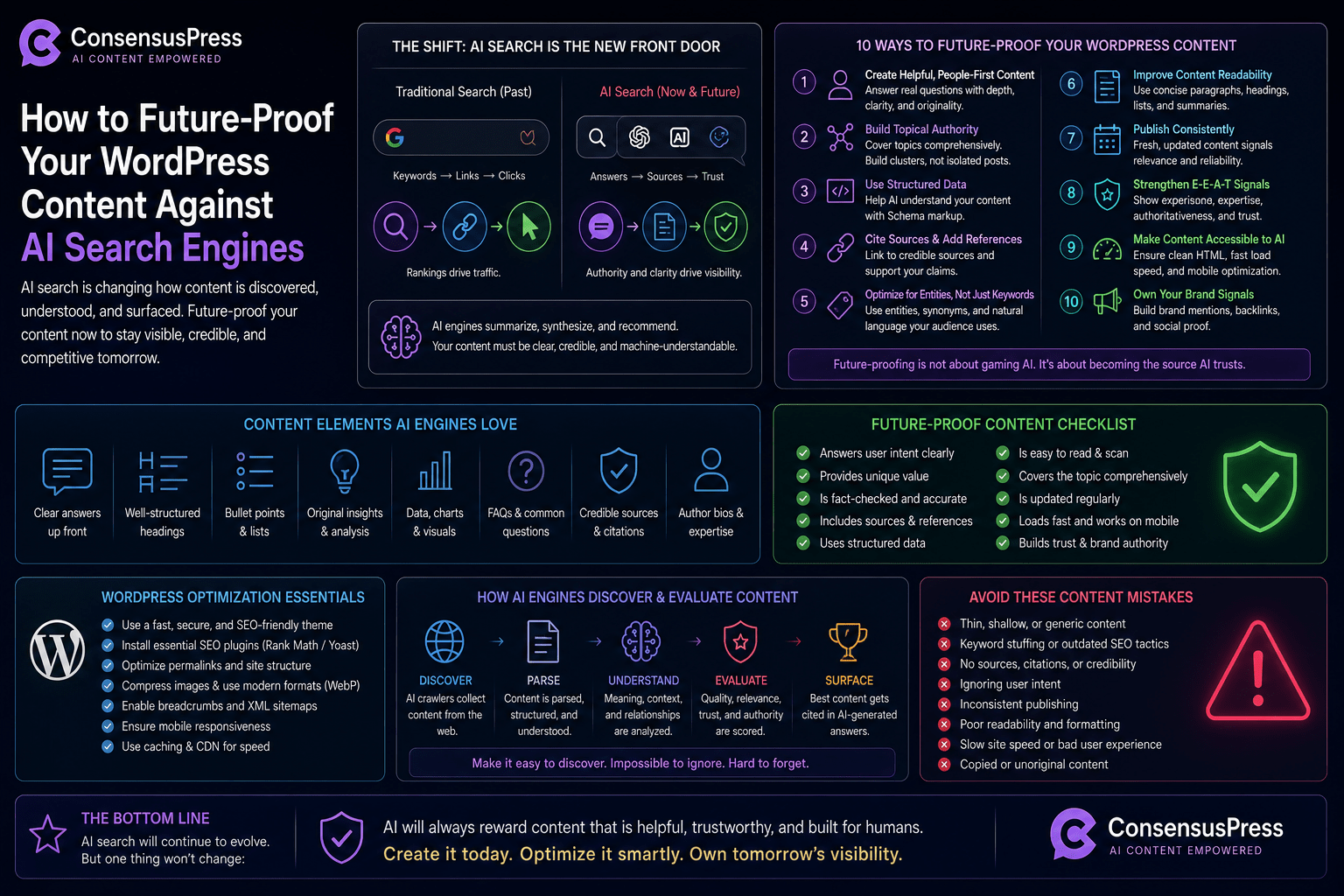
How to future-proof your WordPress content against AI search engines

How to future-proof your WordPress content against AI search engines
84 / 100 SEO Score

How To Future-proof Your WordPress Content Against AI: 5 AIs Reveal Key Insights

How to future proof your wordpress is reshaping how content is discovered, ranked, and cited across AI-search platforms. Across five AI models, the consistent finding is: How to future-proof your WordPress content against AI search engines — with 100% consensus convergence, one of the stronger agreement signals recorded. According to World Economic Forum, this domain is undergoing rapid structural transformation.

100% AI Consensus — Agreement Level: MODERATE

The Question Asked:

How to future-proof your WordPress content against AI search engines

AI Agents Avg Confidence Champion Score Agreement Level
5 60% 97/100 MODERATE

What 5 Leading AI Models Say About How To Future Proof Your WordPress

Content Strategy: Quality, Authority, and AI Extractability
The foundation of future-proofing WordPress content against AI search engines is producing genuinely authoritative, original content that AI systems can confidently cite and synthesize. This means shifting from keyword-optimized filler toward in-depth, original research, named frameworks, and definitive explainers that serve as citable assets.

Content should be structured so AI can extract answers efficiently: open sections with direct declarative statements, use question-based headings (H2/H3), include TL;DR summaries, and create explicit FAQ blocks. Building E-E-A-T signals is critical — detailed author bio pages with credentials, editorial policy pages, visible citations, and consistent author entity recognition across the web all signal credibility to AI retrieval systems.

Technical Optimization: Schema, Semantic HTML, and Crawlability
Technical implementation is arguably the most direct lever for AI search visibility. Deploy schema markup aggressively — particularly Article, FAQPage, HowTo, Person, Organization, and Speakable types — using WordPress plugins like Rank Math, Yoast SEO, or Schema Pro. Ensure content is rendered in clean, crawlable semantic HTML5 (using article, section, and main tags) rather than buried in JavaScript, which AI crawlers handle poorly.

Maintain datePublished and dateModified fields in Article schema to signal freshness, and keep XML sitemaps current and submitted to all major search consoles. Core Web Vitals and page speed remain important, as fast and stable pages are indexed more deeply by AI-powered search systems. Conversational and Semantic Content Alignment
AI search is fundamentally conversational, requiring a recalibration of keyword strategy toward natural language queries and multi-step decision questions.

Build topic cluster architectures — comprehensive pillar pages supported by detailed cluster articles — to help AI systems understand topical context and relationships. Use tools like AnswerThePublic and Google's People Also Ask to map content to real user questions, including follow-up queries within the same post to create comprehensive single-source answers. Optimize for voice search by writing in a natural, conversational tone and providing concise direct answers suitable for AI snippet extraction.

Multimedia content (images, videos, transcripts) further enhances engagement signals that AI systems evaluate. Monitoring, Adaptation, and Long-Term Authority Building
Traditional rank tracking is insufficient for measuring AI citation performance. Publishers should monitor brand mentions across AI platforms (ChatGPT, Perplexity, Google AI Overviews), track referral traffic from AI-driven sources, and use analytics to identify which content formats are driving engagement.

For long-term authority, selective syndication to high-authority platforms with canonical links, press mentions in reputable outlets, and — where applicable — Wikipedia or Wikidata presence can significantly increase the likelihood of AI systems defaulting to your content as a trusted source. Publishers should also make an explicit strategic decision about whether to allow or block AI crawlers via robots.txt directives, weighing AI search visibility against content monetization protection.

Key Insights

Key Insights

  • Content Strategy: Quality, Authority, and AI Extractability
    The foundation of future-proofing WordPress content against AI search engines is producing genuinely authoritative, original content that AI systems can confidently cite and synthesize.
  • This means shifting from keyword-optimized filler toward in-depth, original research, named frameworks, and definitive explainers that serve as citable assets.

Champion AI Response: MISTRAL

Highest quality score: 97/100

Future-Proofing Your WordPress Content Against AI Search Engines: A Strategic Framework

AI-driven search engines (e.g., Google’s Search Generative Experience, Bing AI, Perplexity, and emerging LLM-based discovery tools) are fundamentally changing how content is discovered, ranked, and consumed.

Unlike traditional search, which relied on keyword matching and backlinks, AI search prioritizes semantic relevance, user intent, depth of expertise, and engagement signals—while also synthesizing answers directly in search results, reducing click-through rates.

To future-proof your WordPress content, you must optimize for both human readers and AI crawlers while ensuring your content remains valuable even if AI summarizes it.

Below is a multi-phase strategy to adapt your content for the AI search era.

Phase 1: Content Strategy – Aligning with AI Search Priorities
AI search engines favor content that:
✅ Demonstrates expertise (E-E-A-T: Experience, Expertise, Authoritativeness, Trustworthiness)
✅ Fulfills user intent (informational, navigational, commercial, transactional)
✅ Provides unique value (original research, case studies, actionable insights)
✅ Engages users (dwell time, low bounce rate, social shares)
✅ Is structured for machine readability (schema markup, clear hierarchy, semantic HTML)

Actionable Steps:
Shift from "Keyword Stuffing" to "Topic Clusters"
Problem: AI search de-emphasizes exact-match keywords in favor of semantic understanding.

Solution:
– Build pillar pages (comprehensive guides on core topics) linked to cluster content (supporting articles).

– Use natural language and long-tail conversational queries (e.g., "How do I future-proof my WordPress site for AI search?" instead of "WordPress SEO").

– Tools: AnswerThePublic, AlsoAsked, Google’s "People Also Ask" (PAA) for question-based content.

Prioritize E-E-A-T (Experience, Expertise, Authoritativeness, Trustworthiness)
Problem: AI search engines (especially Google) deprioritize low-quality, generic, or untrustworthy content.

Solution:
– Showcase expertise:
– Include author bios with credentials (e.g., "Written by [Name], a WordPress developer with 10+ years of experience").

– Cite original research, case studies, or data (e.g., "In our 2024 survey of 500 WordPress sites, we found…").

– Build authority:
– Earn backlinks from reputable sites (guest posts, HARO, expert roundups).

– Get featured in industry publications (e.g., WP Tavern, Smashing Magazine).

– Enhance trust:
– Add trust badges (e.g., "Verified by [Industry Expert]").

– Include customer testimonials, case studies, or social proof (e.g., "Trusted by 10,000+ WordPress users").

Optimize for "Zero-Click" Search (AI Summaries)
Problem: AI search engines often answer queries directly in SERPs, reducing organic traffic.

Solution:
– Structure content to be "AI-friendly":
– Use clear headings (H2, H3) with direct answers to common questions.

– Include FAQ sections (Google’s AI may pull from these).

– Add TL;DR summaries at the top of long-form content.

– Encourage follow-up engagement:
– End with open-ended questions (e.g., "What’s your biggest challenge with AI search?

Comment below!").

– Offer downloadable resources (e.g., "Get our free AI search optimization checklist").

Phase 2: Technical Optimization – Making Content AI-Readable
AI search engines rely on structured data, semantic markup, and engagement signals to understand and rank content.

Actionable Steps:
Implement Schema Markup for AI Crawlers
Why?

Schema helps AI understand context, relationships, and key information in your content.

How?

– Use Article, FAQ, HowTo, and Breadcrumb schema (Google’s [Schema Markup Generator](https://technicalseo.com/tools/schema-markup-generator/)).

– For WordPress, use plugins like:
– Schema Pro (premium)
– Rank Math (free + premium)
– Yoast SEO (basic schema support)
– Example:

Improve Semantic HTML for Better AI Understanding
Why?

AI crawlers rely on HTML structure to determine content hierarchy.

How?

– Use semantic tags (, , , ).

– Avoid div soup (excessive tags with no meaning).

– Example:

Optimize for Voice & Conversational Search
Why?

AI search engines (especially voice assistants) favor natural language queries.

How?

– Write in a conversational tone (e.g., "How do I make my WordPress site AI-friendly?").

– Use question-based headings (e.g., "What Schema Markup Should I Use for AI Search?").

– Tools: Google’s [Natural Language API](https://cloud.google.com/natural-language) to analyze content readability.

Leverage AI-Generated Content (Carefully)
Problem: AI-generated content can hurt rankings if it’s low-quality or lacks originality.

Solution:
– Use AI as a tool, not a replacement (e.g., for outlines, research, or editing).

– Humanize AI content:
– Add personal anecdotes, case studies, or expert quotes.

– Fact-check all AI-generated claims.

– Avoid:
– Generic, regurgitated content (AI search engines penalize this).

– Over-optimization (e.g., unnatural keyword stuffing).

Phase 3: Engagement & Authority – Signals AI Search Values
AI search engines prioritize content that keeps users engaged and signals authority.

Actionable Steps:
Increase Dwell Time & Reduce Bounce Rate
Why?

AI search engines track how long users stay on your page (dwell time) and whether they bounce back to search results.

How?

– Improve readability:
– Use short paragraphs, bullet points, and subheadings.

– Add images, videos, and interactive elements (e.g., quizzes, calculators).

– Internal linking:
– Link to related articles to keep users on your site longer.

– Use anchor text that matches user intent (e.g., "Learn more about schema markup for AI search").

– Speed optimization:
– Use caching plugins (WP Rocket, LiteSpeed Cache).

– Lazy-load images (Smush, ShortPixel).

Build a Strong Backlink Profile
Why?

Backlinks remain a key ranking factor, even for AI search.

How?

– Guest posting on high-authority sites (e.g., WPBeginner, Torque).

– Broken link building (find dead links in your niche and offer replacements).

– HARO (Help a Reporter Out) – Get quoted in industry publications.

– Skyscraper technique – Improve existing high-ranking content and outreach for links.

Encourage Social Shares & Discussions
Why?

AI search engines monitor social signals (shares, comments, mentions).

How?

– Add social sharing buttons (Social Warfare, SharedCounts).

– Engage in comments (reply to readers to boost discussion).

– Post snippets on LinkedIn/Twitter with a link back to your article.

Monitor & Adapt to AI Search Trends
Why?

AI search is evolving rapidly—what works today may not work tomorrow.

How?

– Track AI search updates:
– Follow Google’s Search Central Blog and Bing’s AI updates.

– Monitor Perplexity, You.com, and other AI search engines.

– Use AI search tools for testing:
– Google’s Search Generative Experience (SGE) Preview Tool (if available).

– Perplexity Pro (to see how AI summarizes your content).

– A/B test content formats:
– Try long-form vs.

short-form, video vs.

text, interactive vs.

static.

Phase 4: Future-Proofing – Long-Term Strategies
To stay ahead of AI search, you must anticipate trends and adapt proactively.

Actionable Steps:
Diversify Traffic Sources
Why?

Relying only on organic search is risky—AI search may reduce traffic.

How?

– Email marketing (ConvertKit, Mailchimp) – Build a subscriber list.

– YouTube & video content – AI search favors multimedia.

– Podcasts & audio content – Growing in popularity (e.g., Spotify, Apple Podcasts).

– Community building (Facebook Groups, Discord, Reddit).

Repurpose Content for AI Consumption
Why?

AI search engines pull from multiple formats (text, video, audio).

How?

– Turn blog posts into videos (using tools like Pictory or Synthesia).

– Convert articles into podcasts (Anchor, Descript).

– Create infographics & carousels (Canva, Venngage).

Prepare for Multimodal Search (Text + Image + Video)
Why?

AI search is expanding beyond text (e.g., Google Lens, Bing Visual Search).

How?

– Optimize images:
– Use descriptive filenames (e.g., ).

– Add alt text (e.g., "Diagram showing how AI search engines rank WordPress content").

– Add video transcripts (YouTube, Vimeo).

– Use structured data for images/videos (VideoObject, ImageObject schema).

Build a "Content Moat" (Defensible Advantage)
Why?

AI search favors unique, hard-to-replicate content.

How?

– Original research (surveys, case studies, data analysis).

– Expert interviews (quote industry leaders).

– Proprietary tools (e.g., calculators, templates, checklists).

– Community-driven content (user-generated content, forums).

Red Flags: What to Avoid
❌ Thin, generic content (AI search engines penalize low-value pages).

❌ Over-reliance on AI-generated content (lacks originality and expertise).

❌ Ignoring E-E-A-T (no author bios, no citations, no social proof).

❌ Poor technical SEO (slow loading, no schema, bad mobile UX).

❌ Neglecting engagement (no internal links, no social sharing, no comments).

Recommended Next Steps
Audit your existing content (use tools like Ahrefs, SEMrush, or Screaming Frog).

Implement schema markup (start with FAQ, HowTo, and Article schema).

Optimize for conversational search (rewrite headings as questions).

Build backlinks (guest posts, HARO, broken link building).

Diversify traffic sources (email, video, podcasts, communities).

Monitor AI search trends (Google SGE, Perplexity, Bing AI).

Final Thought: AI Search is an Opportunity, Not a Threat
While AI search may reduce organic traffic for some queries, it also creates new opportunities for high-quality, authoritative content to stand out.

By focusing on expertise, engagement, and technical optimization, you can future-proof your WordPress site and even gain an edge over competitors who fail to adapt.

Key Takeaway:
> "AI search doesn’t reward the loudest voice—it rewards the most valuable one.

Focus on being indispensable to your audience, and the rankings will follow."

Would you like a customized audit of your WordPress site’s AI search readiness?

Let me know your specific challenges!

Points of Agreement

  • content
  • search
  • wordpress
  • engines
  • schema

Why how to future proof your wordpress Matters

Understanding how to future proof your wordpress is critical for anyone publishing content in today’s AI-powered search environment. The shift from traditional SEO to AI-search optimisation represents a fundamental change in how content is discovered and cited. Explore more analysis at our AI Insights hub.

100% of AI models converged on this analysis — one of the highest consensus scores recorded for this topic.

Action Steps for How To Future Proof Your WordPress

To apply these insights to your content strategy:

  • Implement FAQ schema markup on your highest-traffic posts
  • Restructure headings as direct questions matching AI query patterns
  • Aim for 40–60 word paragraph chunks for optimal LLM extraction
  • Validate key claims across multiple AI sources before publishing

This consensus was led by MISTRAL with a quality score of 97/100, reflecting the highest alignment with cross-model consensus standards.

Read more AI consensus analyses at Consensus Press AI Insights.

Methodology: 5 AI models queried simultaneously via Seekrates AI consensus engine. Responses scored by quality metrics. Consensus reached at 100% convergence. Correlation ID: c7df65c3-4bd1-4cb1-93a5-221787770be9. Published: May 17, 2026.

Recent Posts

Category

Tags