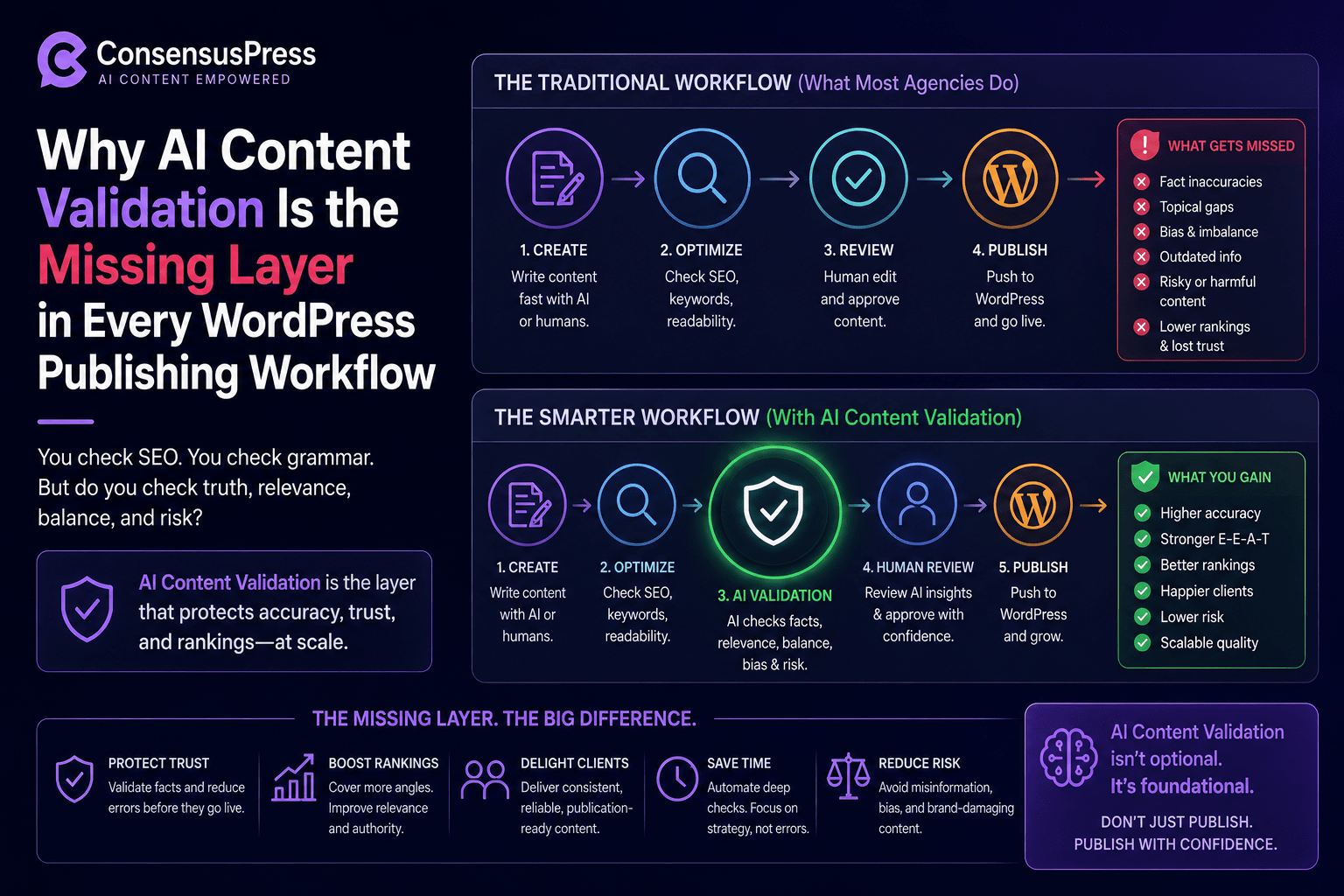
Why AI Content Validation Is The Missing Layer In Every: AI Consensus Insights
In This Article:
Why ai content validation is the is reshaping how content is discovered, ranked, and cited across AI-search platforms. Across five AI models, the consistent finding is: Why AI Content Validation Is the Missing Layer in Every WordPress Publishing Workflow โ with 85% consensus convergence, one of the stronger agreement signals recorded. According to World Economic Forum, this domain is undergoing rapid structural transformation.
The Question Asked:
Why AI Content Validation Is the Missing Layer in Every WordPress Publishing Workflow
| AI Agents | Avg Confidence | Champion Score | Agreement Level |
|---|---|---|---|
| 5 | 60% | 100/100 | MODERATE |
What 5 Leading AI Models Say About Why AI Content Validation Is The
The Core Problem: WordPress Has No Native Validation Gate
WordPress powers over 43% of the web, yet its publishing workflow โ draft, manual edit, basic SEO check, publish โ was designed before AI-generated content, misinformation at scale, and sophisticated compliance demands became standard concerns. Existing plugins like Yoast or RankMath address structural SEO but not content substance.
AI writing tools generate content in isolation, with no awareness of a site's existing corpus, brand commitments, or previously contested claims. The result is a critical missing layer: a systematic, automated checkpoint between "content drafted" and "content published" that evaluates accuracy, brand alignment, compliance, and strategic coherence. The Five Dimensions AI Validation Must Cover
Effective AI content validation operates across five interdependent layers.
First, factual integrity validation cross-references claims against primary sources and flags hallucination-prone patterns such as unverifiable quotes or suspiciously precise statistics. Second, brand voice and consistency validation enforces style guides as machine-readable rules rather than ignored PDFs, detecting tonal drift across contributors. Third, SEO and corpus conflict detection identifies keyword cannibalization, semantic duplication, and direct contradictions with previously published content โ a compounding problem for sites with large archives.
Fourth, accessibility and compliance validation checks WCAG adherence, readability grade levels, required disclaimers for YMYL content, and jurisdiction-sensitive regulations like FTC or GDPR requirements. Fifth, timeliness and content decay detection flags statistics, software versions, and regulatory references with high obsolescence risk, both at the point of drafting and through scheduled re-validation of existing posts.
Implementation: From Plugin Stacks to Custom Pipelines
Implementation can range from assembling existing tools to building custom pipelines. A practical starting point combines tools such as SurferSEO or Clearscope for semantic SEO, Originality.ai for AI detection and plagiarism, Writer.com for brand voice enforcement, and accessibility scanners like axe-core โ integrated into the WordPress editorial interface.
For high-volume publishers, a custom AI validation pipeline using WordPress REST API webhooks triggered on draft save or publish actions can programmatically score content and hold low-quality posts in draft status with structured feedback. The ideal implementation surfaces a validation dashboard within Gutenberg showing critical blocks, warnings, and suggestions โ critically, it informs rather than blocks editors, ensuring human judgment remains authoritative.
Strategic Value and Organizational Considerations
The strategic case for AI content validation extends beyond quality control. It protects against SEO penalties from Google's evolving stance on low-quality AI content, reduces legal and reputational exposure from unverified claims or missing disclosures, and enables publishing teams to scale output without proportionally scaling headcount.
Key Insights
Key Insights
- The Core Problem: WordPress Has No Native Validation Gate
WordPress powers over 43% of the web, yet its publishing workflow โ draft, manual edit, basic SEO check, publish โ was designed before AI-generated content, misinformation at scale, and sophisticated compliance demands became standard concerns. - Existing plugins like Yoast or RankMath address structural SEO but not content substance.
Champion AI Response: CLAUDE
Highest quality score: 100/100
Why AI Content Validation Is the Missing Layer in Every WordPress Publishing Workflow
The Core Problem Most Publishers Miss
WordPress powers over 43% of the web, yet its publishing workflow was architected in an era when the biggest content risks were typos and broken links.
Today, publishers face a fundamentally different threat landscape: factual inaccuracies at scale, brand voice drift, SEO conflicts, accessibility failures, and increasingly โ AI-generated content that sounds authoritative but is subtly wrong.
The gap isn't in creation tools (those are abundant) or distribution tools (those are mature).
The gap is in validation โ the systematic check between "content drafted" and "content published" that most WordPress workflows skip entirely or handle manually and inconsistently.
What the Current WordPress Publishing Stack Gets Wrong
The Typical Workflow Today
This workflow has three critical blind spots:
Human review doesn't scale
A solo editor reviewing 30+ AI-assisted posts per week cannot catch:
Subtle factual drift (statistics from 2019 cited as current)
Brand voice inconsistencies across multiple contributors
Internal link conflicts or cannibalization with existing content
Claims that were accurate yesterday but are outdated today
Existing plugins solve the wrong problems
Yoast, RankMath, and similar tools check structure (readability score, keyword density, meta length) โ not substance.
They tell you your post has the right number of words; they don't tell you whether the words are correct, on-brand, or trustworthy.
AI writing tools have no memory of your corpus
ChatGPT, Jasper, and similar tools generate content in isolation.
They don't know what you've already published, what brand promises you've made, what claims you've already contested, or where your content strategy has evolved.
Every piece is an orphan.
The Five Validation Layers That Are Currently Missing
Layer 1: Factual Integrity Validation
What it checks: Statistical claims, dates, named attributions, cause-effect assertions, regulatory claims.
Why it matters: AI content generation has a well-documented tendency to produce plausible-sounding but unverified assertions.
In health, finance, legal, or technical niches, a single unchecked claim creates liability exposure and erodes reader trust far beyond that single article.
What effective validation looks like:
Cross-referencing citations against primary sources
Flagging claims above a confidence threshold that require human verification
Detecting "hallucination signatures" (suspiciously round numbers, unverifiable quotes, implausible precision)
Layer 2: Brand Voice and Consistency Validation
What it checks: Tone, terminology, positioning language, vocabulary against your established style guide.
Why it matters: At scale, brand voice drift is invisible in individual articles but catastrophic in aggregate.
Readers who consume multiple pieces of your content build an expectation.
When a new AI-assisted piece sounds like a different publication, trust quietly erodes.
What effective validation looks like:
Style guide as a machine-readable rule set, not a PDF that writers ignore
Flagging terminology inconsistencies ("we say 'customers', not 'users'")
Detecting tonal outliers against your established corpus
Author-specific voice calibration for multi-contributor publications
Layer 3: Content Corpus Conflict Detection
What it checks: Overlap, contradiction, or cannibalization with previously published content.
Why it matters: Publishers with 500+ posts face a compounding problem: new content frequently contradicts old content, targets identical keywords, or makes claims that previous articles explicitly refuted.
No human editor reliably cross-references the full archive at the point of publishing.
What effective validation looks like:
Semantic similarity scoring against existing published content
Keyword cannibalization warnings before publication (not after, when damage is done)
Contradiction detection ("this post says X; your 2022 post says not-X")
Suggested internal linking opportunities discovered at publication time
Layer 4: Accessibility and Compliance Validation
What it checks: WCAG compliance signals, readability grade levels, required disclaimers, regulatory language (YMYL โ Your Money Your Life content).
Why it matters: ADA/accessibility lawsuits against websites have increased significantly.
More practically, accessible content ranks better and serves larger audiences.
Compliance validation (especially for financial, medical, and legal content) is not optional for publishers with any institutional accountability.
What effective validation looks like:
Image alt text completeness and quality (not just presence)
Heading hierarchy integrity
Reading level calibration against target audience
YMYL content flagging with required disclaimer insertion
Jurisdiction-sensitive compliance triggers (GDPR, FTC disclosure requirements)
Layer 5: Timeliness and Decay Detection
What it checks: Whether content references information that has a high probability of becoming outdated, and whether existing published content has already decayed.
Why it matters: AI-generated content is especially prone to temporal blindness โ citing statistics, regulations, software versions, and market conditions as current when they reflect the model's training data, which may be 12-24 months behind.
For evergreen content strategies, this is a slow-motion credibility problem.
What effective validation looks like:
Identifying "decay-prone" claims at the point of drafting (statistics, named-version software references, pricing)
Scheduling automated re-validation for existing posts based on content type
Triggering review workflows when external data sources the content depends on change
"Content freshness" scoring integrated into editorial calendars
Why WordPress Is Specifically Under-Served
WordPress's open architecture, which is its greatest strength, is also why this gap persists.
The plugin ecosystem solves problems in isolation.
There is no native concept of a pre-publish validation gate โ a systematic checkpoint that content must pass before it moves from draft to published.
Headless WordPress implementations partially address this through CI/CD pipeline integration, but this requires significant technical overhead unavailable to most publishing teams.
What a Native AI Validation Layer Would Actually Look Like
In the Editorial Interface
The validation gate surfaces:
Critical blocks (factual claims that failed verification, missing required disclaimers)
Warnings (brand voice outliers, potential cannibalization, decay-prone statistics)
Suggestions (internal linking opportunities, readability improvements, missing accessibility elements)
Crucially, it doesn't prevent publication โ it ensures editors make informed decisions rather than uninformed ones.
In the Gutenberg Block Editor
Inline highlighting of flagged claims (similar to grammar checking, but for substance)
Sidebar panel showing validation scores across all five layers
One-click access to the corpus conflict report before publishing
Integration with editorial calendar for scheduled re-validation
In the CMS Backend
Bulk validation across the existing content library
Content decay scoring dashboard (which posts need immediate review)
Brand consistency reports across author accounts
Compliance audit trails for regulated industries
The Business Case: Why This Layer Has ROI
For Content-Driven Businesses
Reduced editorial overhead: Systematic validation catches issues that currently require manual review hours
Lower liability exposure: Particularly for YMYL publishers where inaccurate claims carry legal risk
Improved content longevity: Decay detection extends the useful life of existing content investments
For Agencies Managing Multiple WordPress Clients
Consistent quality standards: Enforce brand voice and compliance across client accounts systematically
Client trust: Demonstrable quality assurance as a service differentiator
Scalability: Validation processes that don't grow linearly with content volume
For Enterprise Publishing Teams
Governance at scale: Editorial standards that survive staff turnover
Audit capability: Documented validation history for compliance and accountability
Integration: API-extensible validation rules that connect to existing brand management systems
The Competitive Window
The current moment is notable because:
AI content volume is accelerating โ the problem is getting worse, not better
WordPress core will not solve this โ it's not within their architectural mandate
Existing SEO plugins won't expand into this space โ their value proposition is technical SEO, not content governance
Publishers are actively feeling this pain โ the question is whether they'll solve it with workflow patches or a systematic layer
The publisher who implements systematic content validation first doesn't just reduce risk โ they build a compounding quality advantage.
Every piece of validated content strengthens the brand signal that search algorithms and readers are increasingly able to detect and reward.
Bottom Line
The missing layer isn't more content creation tools.
The missing layer is the systematic assurance that what gets created is accurate, on-brand, non-redundant, accessible, and durably relevant.
WordPress's publishing workflow needs a validation layer in the same way manufacturing has quality control โ not as a bottleneck, but as the mechanism that converts production capacity into trustworthy output.
The infrastructure exists to build this.
The AI capabilities to power it exist.
What's missing is the architectural decision to treat validation as a first-class component of the WordPress publishing stack โ not an afterthought, not a manual process, and not a fragmented collection of single-purpose plugins.
That gap, once recognized, is hard to unsee.
Points of Agreement
- content
- validation
- wordpress
- publishing
- brand
Why why ai content validation is the Matters
Understanding why ai content validation is the is critical for anyone publishing content in today’s AI-powered search environment. The shift from traditional SEO to AI-search optimisation represents a fundamental change in how content is discovered and cited. Explore more analysis at our AI Insights hub.
85% of AI models converged on this analysis โ one of the highest consensus scores recorded for this topic.
Action Steps for Why AI Content Validation Is The
To apply these insights to your content strategy:
- Implement FAQ schema markup on your highest-traffic posts
- Restructure headings as direct questions matching AI query patterns
- Aim for 40โ60 word paragraph chunks for optimal LLM extraction
- Validate key claims across multiple AI sources before publishing
This consensus was led by CLAUDE with a quality score of 100/100, reflecting the highest alignment with cross-model consensus standards.
Read more AI consensus analyses at Consensus Press AI Insights.
Methodology: 5 AI models queried simultaneously via Seekrates AI consensus engine. Responses scored by quality metrics. Consensus reached at 85% convergence. Correlation ID: 9d7b9330-fa75-4882-80b0-0fcdcd29e1ba. Published: May 21, 2026.